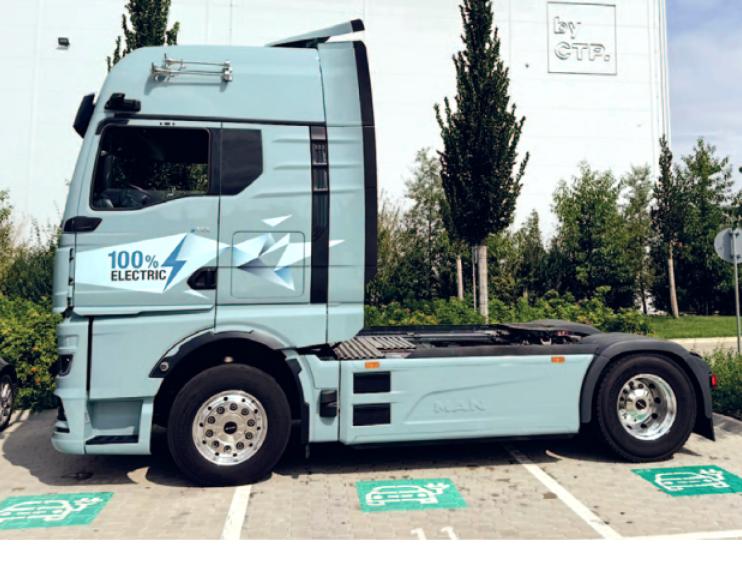

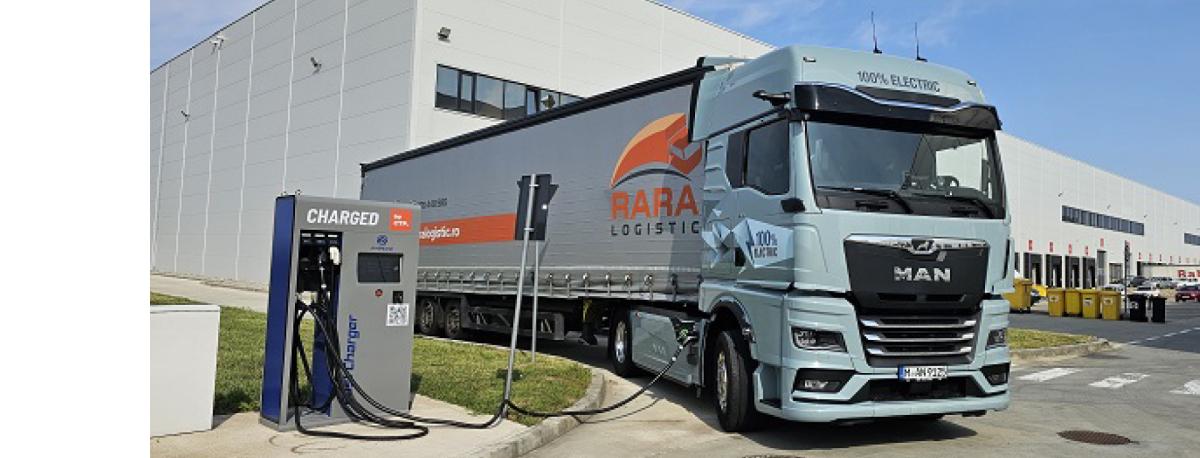





The RARA Logistic official is convinced that electric transport will not be profitable, in an initial phase. „It's a bet you make in order to learn. Basically, you're paying for a school. Initially, I wanted to wait for the state aid scheme, but later, we decided to take the risk. We are currently analyzing the purchase of one or two electric trucks, without subsidy, but their number could double, if we could benefit from such state aid”, added Rares Sarbu.
Calculations…
Although they do not expect an immediate profit, RARA has done all the calculations to maximize the efficiency of electric transport. First of all, you have to take into account the acquisition cost. „Electric trucks are much more expensive than classic ones. For example, at MAN, the difference between a TGX and an eTGX is about 160,000 euros, an amount you have to somehow recover. In principle, all customers declare themselves in favor of reducing the carbon footprint. But they do not want to pay extra or invest in installing charging stations at their factories or warehouses.”
Then there are the calculations related to possible operations. „Electric trucks have a declared range of up to 500 km, but the real one varies between 300 and 400 km. Loaded, in winter you'll do 300, in summer 400, maybe 450 km, if the driver is conscientious and uses regenerative braking. So you have to calculate your route and the trips made very well.”
Perhaps the most important aspects are, however, those related to operating costs. With an average consumption of 110 kW per 100 km, if you charge at public stations, at 2.7 lei per kWh, you have an equivalent consumption of 46 liters of diesel per 100 km. „No truck consumes that much. So, for it to be efficient, you should use as much electricity as possible at grid price, which translates into an equivalent diesel consumption of 10-12 liters per 100 km. Which, today, means charging at your own depot, equipped in advance with photovoltaic panels, or buying electricity from a partner, at an acceptable price”, Rares Sarbu specified.
According to the calculations, electric transport can become profitable in two situations: either the client pays a higher rate, or you do many kilometers and then you gain from the difference in fuel costs. „I need to do somewhere around 500 kilometers daily, so that I can amortize the price difference in about three years. Without at least 10,000 km per month, you have no chance”, the general manager of RARA Logistic estimated.
Rares Sarbu, owner RARA Logistic: „My dream is to no longer buy diesel by tanker, every week. If we burn tens of thousands of liters of diesel, what happens to the environment? We are trying to create an ecological distribution system for our customers. We operate in CTP warehouses in Sibiu, Bucharest and Deva and we want to expand to other points in the country as well. We aim for all the distribution we do around these hub-uri to be electric.”
Calculations…
Although they do not expect an immediate profit, RARA has done all the calculations to maximize the efficiency of electric transport. First of all, you have to take into account the acquisition cost. „Electric trucks are much more expensive than classic ones. For example, at MAN, the difference between a TGX and an eTGX is about 160,000 euros, an amount you have to somehow recover. In principle, all customers declare themselves in favor of reducing the carbon footprint. But they do not want to pay extra or invest in installing charging stations at their factories or warehouses.”
Then there are the calculations related to possible operations. „Electric trucks have a declared range of up to 500 km, but the real one varies between 300 and 400 km. Loaded, in winter you'll do 300, in summer 400, maybe 450 km, if the driver is conscientious and uses regenerative braking. So you have to calculate your route and the trips made very well.”
Perhaps the most important aspects are, however, those related to operating costs. With an average consumption of 110 kW per 100 km, if you charge at public stations, at 2.7 lei per kWh, you have an equivalent consumption of 46 liters of diesel per 100 km. „No truck consumes that much. So, for it to be efficient, you should use as much electricity as possible at grid price, which translates into an equivalent diesel consumption of 10-12 liters per 100 km. Which, today, means charging at your own depot, equipped in advance with photovoltaic panels, or buying electricity from a partner, at an acceptable price”, Rares Sarbu specified.
According to the calculations, electric transport can become profitable in two situations: either the client pays a higher rate, or you do many kilometers and then you gain from the difference in fuel costs. „I need to do somewhere around 500 kilometers daily, so that I can amortize the price difference in about three years. Without at least 10,000 km per month, you have no chance”, the general manager of RARA Logistic estimated.
Rares Sarbu, owner RARA Logistic: „My dream is to no longer buy diesel by tanker, every week. If we burn tens of thousands of liters of diesel, what happens to the environment? We are trying to create an ecological distribution system for our customers. We operate in CTP warehouses in Sibiu, Bucharest and Deva and we want to expand to other points in the country as well. We aim for all the distribution we do around these hub-uri to be electric.”